We are passionate supporters of entrepreneurship in all its forms, and we know that we are but one option for founders looking to build their companies. In Moody’s YouTube channel, Venture Kills, and Seth’s book, The New Builders, they talk in depth about this and the huge promise that small business owners hold for the future of the American economy. So when High Alpha Studio company, Castiron, launched in October of this year, we couldn’t wait to get involved.
Castiron is enabling artisanal food creators to build their businesses with a platform that helps them create a web presence, manage sales, track inventory, and reach customers. Their blog is a crash course in how to start a culinary business, with helpful tips on pricing, SEO, and influencer marketing. Users can get started for free, with no credit card required. Castiron is tailor made for its target audience: folks who are scrappy makers, people who want to focus on their passion, and those who are new to direct-to-consumer business.
We learned about Castiron through our relationship with co-founder and CEO, Mark Josephson. Moody has known Mark for a long time through board work they did together on a non-profit consortium. We introduced Mark to our partner, High Alpha Studio, and they recruited him to co-found the company earlier this year. When we learned that they were raising a round led by another partner, Bowery Capital, we quickly engaged, despite the fact that the stage of Castiron is a little earlier than we typically invest in.
Castiron is a SaaS-enabled Marketplace investment, an area in which we have a lot of expertise. Mark is deeply devoted to the entrepreneurs he is supporting, and we could not be happier to partner with him in that effort. Small business owners have so much to offer our communities and the broader American economy, and we look forward to working with Castiron as they make the cottage food industry more accessible to makers of all kinds.
Our Investment in Bolster
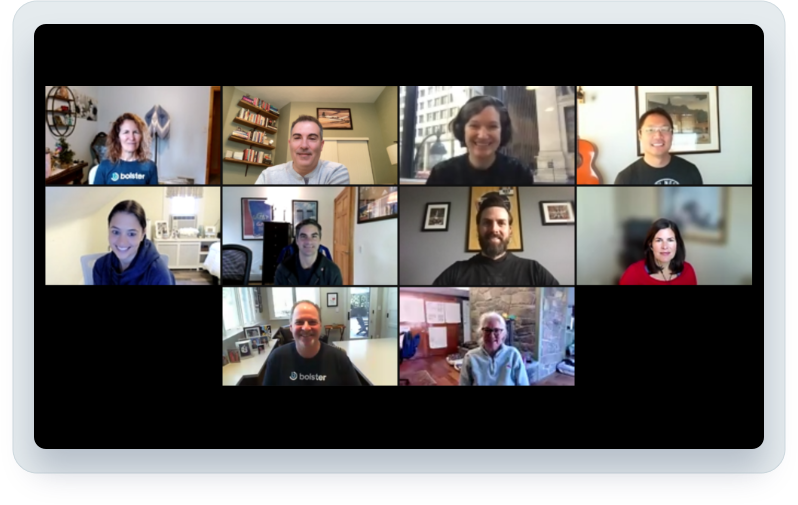
Bolster’s leadership team, entirely remote in 2021
At Foundry, we’re building what we describe as a “network-first” strategy. The vast majority of our new investments come from a network of over 40 early-stage VC funds in which we are LPs. Through these investments, we are indirect investors in several thousand companies. We co-founded Techstars, which, as a worldwide network that helps entrepreneurs accelerate their businesses, has over 2,000 active portfolio companies and is making over 500 new investments each year around the world. A decade ago, I coined the term “startup community” and wrote the original book about the topic, Startup Communities: Building an Entrepreneurial Ecosystem in Your City, based on the premise that building startup communities in every city in the world are an essential part of the global democratizing of entrepreneurship. Today, we have invested in Bolster, another company built fundamentally around a network premise in entrepreneurship.
Bolster is a marketplace for on-demand executive talent, which helps startup CEOs scale themselves, their leadership teams, and their boards. The Bolster marketplace matches startups with executives for interim, fractional, and advisory roles, along with board appointments and full-time jobs. Bolster also offers robust mentorship and advisory services. In addition, its unique mix of software and programming, along with its diversity partnerships, are helping investors grow their hiring networks. Since its launch in September 2020, almost 7,000 curated senior executives have joined Bolster as members, and over 1,000 founders and CEOs have joined Bolster as clients, a testament to the growing workforce trend of on-demand and flexible work opportunities that exploded with the pandemic and the mainstreaming of remote work in 2020 and 2021.
Matt Blumberg co-founded Bolster with key people from his leadership team at Return Path, High Alpha, and Silicon Valley Bank. Union Square Ventures led the early financing with participation from Costanoa Ventures. As a result, we had a front-row seat to witness Bolster’s early development as indirect investors through three partner funds (Union Square Ventures, Costanoa Ventures, and High Alpha). We have also been an active early Bolster portfolio partner, with our portfolio companies using Bolster for over 30 executive or board placements last year.
The relationships that led to the financing reinforce the premise behind Bolster’s view of a network model for talent. Return Path (Matt’s previous company) and Exact Target (the previous company of the founders of High Alpha) had a strategic relationship. Foundry, Union Square Ventures, and Costanoa were investors in Return Path. Foundry is an LP in Union Square Ventures, Costanoa, and High Alpha. SVB has been a long-time partner with Foundry and has a strategic relationship with High Alpha and Techstars. And, this is the second time around together for Matt and his co-founders, who were part of the Return Path leadership team.
We are excited to add another high-growth entrepreneurial network to the broader Foundry network. And it’s a joy to get to work with Matt and his team again.
Our Investment in Sofar
At Foundry, we care deeply about the planet. As hikers, runners, cyclists, skiers, sailors, and anglers, we love to play in the mountains and the oceans. We depend on the outdoors for not just recreation, but for the replenishment that time in nature can provide.
Our engagement in the outdoors and our involvement and support of environmental organizations has led us to closely follow a new wave of for-profit technology companies working to solve major climate challenges. We’ve monitored many of these companies as our network of partner funds began investing in climate- related entities. We’ve now invested in two companies directly, teaming with our partner funds as they identify some of the most compelling opportunities. Our latest, Sofar Ocean, is a great example of our network model at work.
From its San Francisco offices, Sofar is driving oceanographic research and shipping industry efficiency through its worldwide network of ocean sensors that provide data on currents, weather, water temperature, and a host of other metrics. Sofar’s subscription- based data products provide access to information on all five of the planet’s oceans. Their customers include hundreds of climate and ocean scientists, more than a dozen global shipping carriers, and international government agencies that leverage its IoT- enabled ocean intelligence platform for applications including: climate research; fuel-efficient ocean mobility; offshore energy site and risk assessment; weather models and forecasting; and protection of coastal communities and local economies.
Sofar is run by four co-founders and led by CEO, Tim Janssen, who merged ocean wave measurement platform, Spoondrift, with underwater drone manufacturer, Open ROV, in 2019. The co-founders are scientists and entrepreneurs with complementary backgrounds in software, engineering, and oceanography. They are deeply committed to solving environmental problems with data.
“At Sofar, we aim to deliver large-scale ocean data to accelerate climate insights….Ocean data and insights are increasingly critical for successful climate mitigation and adaptation…. Over the last few decades, with advances in IoT [Internet of Things] technology and distributed sensing, we’ve become great at collecting data at scale on land and in space. Oceans are now the last frontier….Our mission is to build a more sustainable future powered by ocean intelligence.”
Sofar’s data network and software offerings combine a number of our themes that we’ve seen across our portfolio. We have a long history of working with hardware- enabled software through our HCI theme. Our comfort with the hardware element (ocean sensors) got us excited about the data network and the offerings that could be built on top of it. Sofar’s ocean and weather data as a service offering naturally fits into our Glue theme, enabling other applications and software to be built on top of it. Their initial vertical product, Wayfinder, dynamically optimizing routes for the shipping industry, is a subscription- based enterprise software that we are very familiar with from a go-to-market perspective. Through this, we were able to look at Sofar through the lens of our themes and portfolio experience in combination with the signal offered by our network.
We were introduced to Sofar by Jon Callaghan of True Ventures. We, in turn, introduced Sofar to another partner fund, Union Square Ventures that is investing alongside us in this round. We’ve invested with True and USV across a large portfolio of companies over the life of our respective firms (We joke that Foundry, investing alongside True and USV, creates a “trifecta of goodness”. At least we like to think so!) On its own, we found Sofar’s thesis compelling, but the additional signal provided by our partners solidified our conviction around the investment. We are delighted to join them in support of Sofar’s mission to deliver a new level of ocean intelligence to the market.
Our Investment in LOOP
“I love my car insurance company.” Said no one, ever. Today’s car insurance market is broken. Underwriting practices are irrelevant and discriminatory. Customer service and claims-processing are slow. Brands are outdated (and cheesy). The behemoths of the $256 billion auto insurance industry are overlooking major demographic and cultural shifts. Enter, LOOP.
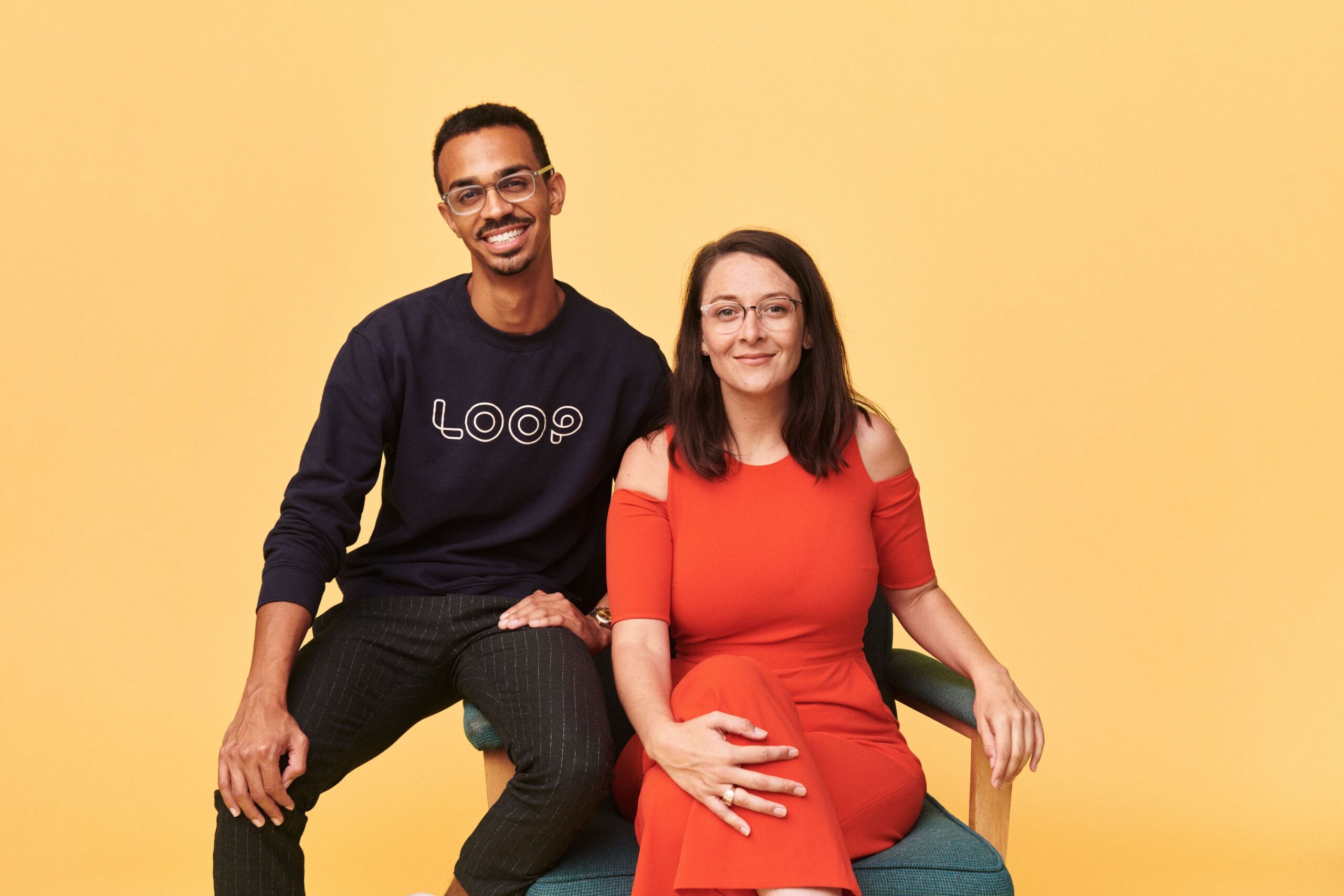
LOOP Co-founders John Henry (left) and Carey Anne Nadeau
LOOP is car insurance you’ll love, built for the 21st century. Powered by truly differentiated technology, LOOP is going after the opportunity to serve a massive, yet overlooked and undervalued population. Instead of underwriting policies based on demographic information like credit score, occupation, and education, LOOP’s approach is actually tied to driving. Leveraging real-time data and AI, LOOP measures driver performance, along with weather, traffic, and collision data, to price policies for customers. This results in more competitive rates for underserved populations like millennials, renters, and immigrants.
LOOP launched last month in Texas with a waitlist of over 30,000 drivers drawn to the idea of modern, fairly priced auto insurance. With its commitment to equity and community-building, LOOP resonates with a generation of consumers who think about values and personal connection when making a purchase decision. The company’s “digital everything” approach not only makes the customer experience fast and easy, but also has the potential to help customers drive more safely, which is good for all of us. LOOP is also a B Corp (like us!).
The company is headed by co-founders John Henry and Carey Anne Nadeau. John was previously co-founder and venture partner at Harlem Capital. He also spent time at VICE Media creating Hustle, a show about entrepreneurship. Carey Anne is an expert in urban economics and spatial analysis. Before LOOP, she held roles at MIT and The Brookings Institution. The diverse backgrounds of this duo bring the kind of unique perspective essential to industry disruption.
Our investment in LOOP is a beautiful example of our network-driven strategy and how we work with our partner funds. We were initially introduced to the team by one of our portfolio CEOs, Craig Lewis (Gig Wage), when LOOP was raising its seed round. It was too early for us at that point (we typically invest at Series A, sometimes later), so we introduced them to Dave Samuel at our partner fund, Freestyle, who had recently mentioned an insurance thesis. Freestyle led the seed round and was joined by another Foundry partner fund, Concrete Rose. We kept a close eye on LOOP and let Dave know of our interest in the next round. When the time was right, we teamed up with Adam Bain and Dick Costolo at our partner fund, 01 Advisors, to co-lead the round. One company, three great Foundry partner funds working alongside us.
LOOP’s mission is to use technology to create equitable insurance for all, and we couldn’t be more thrilled to be along for the ride (pun intended). You can read more about LOOP here and get a quote here.
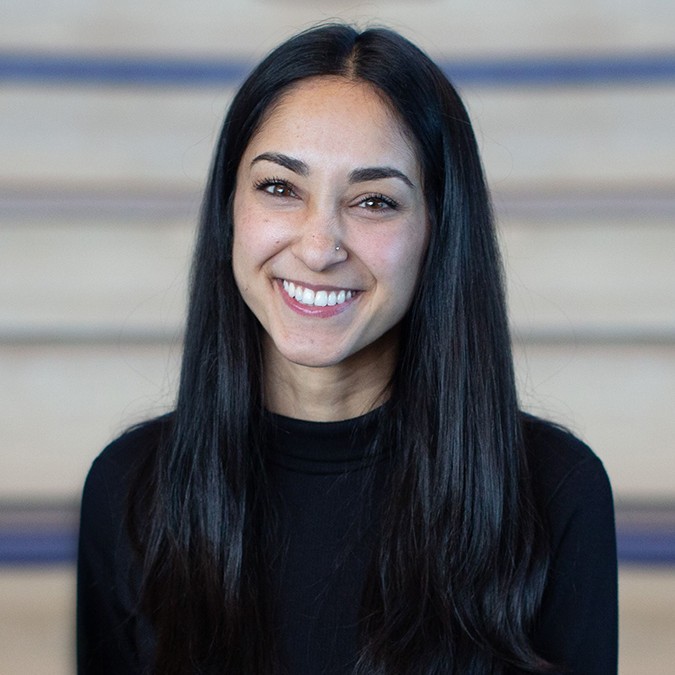
Hello from Foundry’s newest Investor
A few weeks ago I joined the investment team at Foundry, and I wanted introduce myself and share more about why I joined this phenomenal team.
I grew up in the San Francisco Bay Area in two fairly different worlds. My dad was an immigrant from India, while my mom spent her childhood bouncing between Indianapolis and Spain. Growing up in different cultures and religions taught me to constantly ask why – why did we pray to both Jesus and the goddess Lakshmi? Why did one side of my family eat with a fork and knife and the other half with their hands? Why did one side of my family go to private school and college and the other didn’t?
My upbringing also taught me how to build relationships with extremely different people. From playing with neighborhood kids in my mom’s hometown to riding the rickshaw with my cousins to school, I realized I could find common ground despite obvious differences.
I took both those traits into my early career in startups and tech. My time at Clever was particularly formative – I quickly learned that asking questions wasn’t enough. Everyone at a startup is tasked with experimenting with different solutions, and I loved getting to partner with a smart, passionate and diverse set of people to solve problems across the educational system.
After a few years at Clever, and then Slack, I knew I loved the lean and scrappy world of startup life. After noodling on business school for about three years I finally pulled the trigger and enrolled at Northwestern’s Kellogg School of Management. I knew I wanted to stay within the tech ecosystem but wanted to take some time in an academic setting to do some professional and personal exploration. In my first few months I enrolled in the MIINT impact investing competition and realized there was an entirely different career path (venture capital) which I hadn’t explored and that fit so many of my natural personality traits.
I love investing for two main reasons. First, founders are some of the most inspiring people I’ll ever meet. In my experience every entrepreneur starts a company to tackle a problem they’ve seen personally. Getting to hear their story, and how they’ve channeled their creativity and drive to solve a problem, is a privilege I hope to never lose sight of throughout my career. Second, I’ve found a job where my curiosity is rewarded. I get to dig into interesting problems and meet the incredible people who are solving them. I’ve experienced how startups could improve health outcomes for low-income communities during my time at Kapor Capital. I spent time exploring the growing market of Latinx consumers when I worked at Chingona Ventures. And I got to build out the midwest presence for Rough Draft Ventures.
Interviewing for VC roles is – quite frankly – brutal. Hearing “no” repeatedly and constantly feeling like you could be doing more gives you the smallest sliver of understanding and enormous respect for what entrepreneurs go through every day. But after two years of serious hustle, my interactions with Foundry were refreshing: the team emphasized that they wanted to be helpful, giving me guidance on my job search, making introductions to different funds, and advocating for me during the interview process. Perhaps what stood out the most about the Foundry team was behavior that I’ve come to find is a core value of the firm: “Give first.”
I’m so grateful to join a team that deeply values relationships and supports founders and GP’s curiosity and drive. I’m already seeing how they channel those same qualities into their relationships with one another and with me.
I’ll be splitting my time between Boulder and New York City and am looking forward to meeting founders and investors across the country. You can reach me on Twitter @AngeliAgrawal or at angeli@foundrygroup.com.
P.S. Special thank you to VC University – I received a scholarship for their online education program this past spring, through which I met the Foundry team.